

Introducing: Future Testing
A new foresight format.

I’ve been incubating a new format since the start of the year, and have finally crystallised something I’m happy with. So here it is! True to the name, Future Testing is about testing out possible futures in a controlled way.
If you’re someone whose job relies on cultural sensemaking, you’ll know that in today’s information environment the need to approach sensemaking with intention has never been greater. And with AI tools making the “bagging and tagging” of trends more efficient than ever, the value of the human in the loop becomes about curation: deciding where to anchor yourself in a sea of change.
I hope this format can help deliver that. The aim is to produce something that’s fun, digestible and useful at the same time. Think of it as a multifunctional supplement for cultural strategists, foresight practitioners and the future-curious, constantly asking themselves “what now?”
Instead of covering several topics or trends, I will focus on just one real-world development each time, then its ripple effects, and the worlds those ripples could give rise to. So each instalment of Future Testing will run the same controlled experiment in three steps. Let me break each of those down for you:

A spark is my term for a single, consequential development — what foresight would typically call a central change or event. How do I determine what counts as a ‘spark’? My approach is about searching for convergences. This was inspired by Amy Webb, a strategic foresight heavyweight who recently shifted her work’s centre of gravity from trend reports to “convergence outlooks”. In fact she made quite a show of it, staging a mock funeral at SXSW 2026, with a marching band later entering the room to celebrate the beginning of her new type of report.
Theatrics aside, I think her argument holds weight: in a world of constant change, particularly when it comes to technology, annual trend reports become obsolete before leaders even finish reading them. The real work of foresight isn’t cataloguing trends one by one, but understanding how they influence and interact with each other.
While Webb’s work is about data-informed macro-level foresight, that's not the focus of this format. To give you an example of my thinking, take the recent news of Bumble announcing the end of the swipe, likely in favour of an AI matchmaking assistant. It’s a sign of change, no doubt, but it also shows how several forces are meaningfully converging: sophisticated consumer-facing AI (technological), a collective yearning for a more meaningful dating culture (cultural), and dating app fatigue threatening user retention and revenue (economic).
So the spark would be something like: “a major dating app is replacing swiping with AI matchmaking”.

If a spark is about a shock to the system, the implications are about its shockwaves.
Here, I’ll be drawing on the Futures Wheel, a well-known foresight framework for working through the knock-on effects of a consequential development.
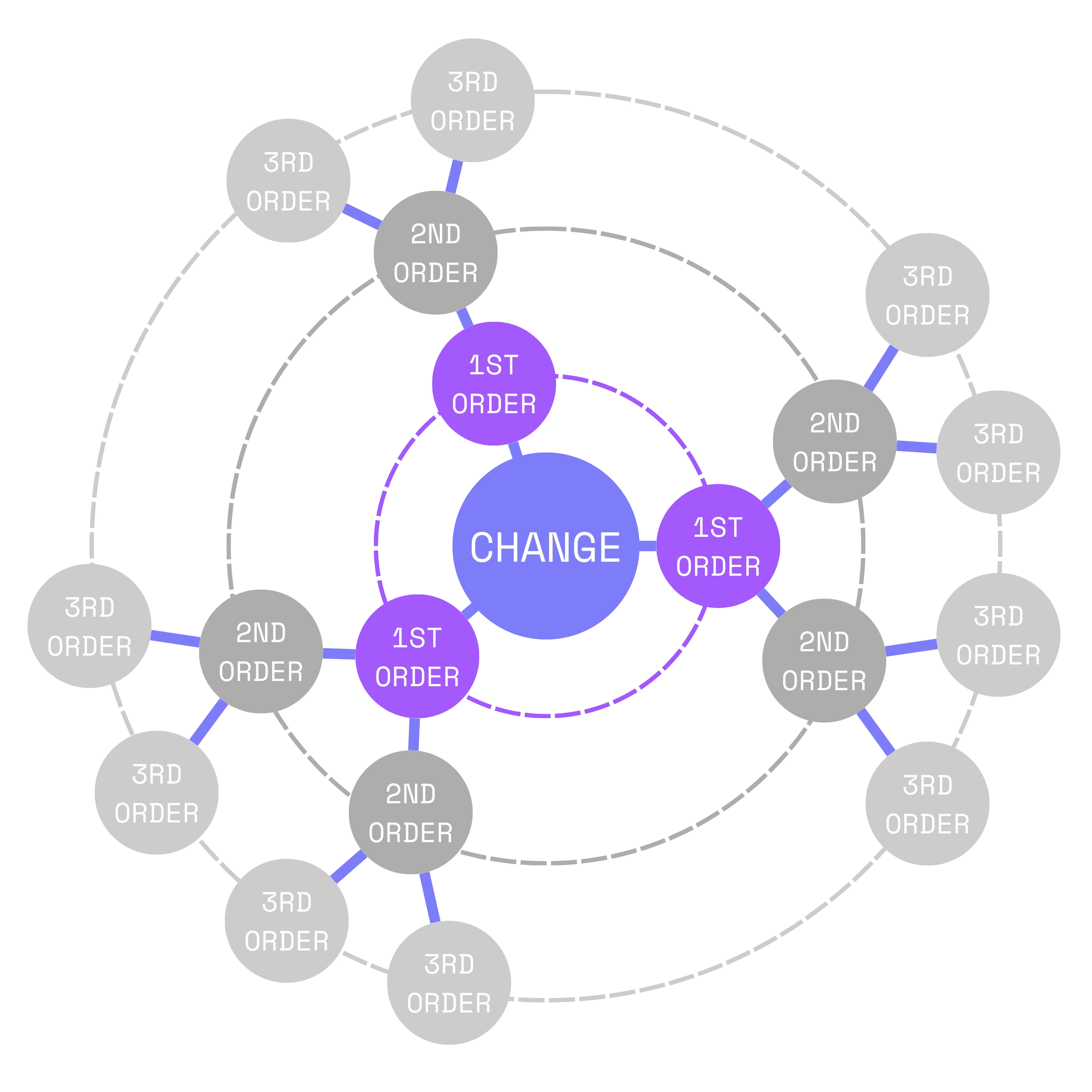
I’ll be giving you a curated, bite-sized version of this, limited to just three types of consequences:
Define (the meaning shift): how the change reshapes what people believe, value or desire.
Relate (the social shift): how it reorganises relationships, roles and the structures that hold people together.
Destroy (the dissolution): what gets cleared away or made obsolete, and what that clearing makes room for.
For the framework nerds out there, this approach is taken from the Verge framework, which uses an ethnographic lens to map out how change impacts people across different domains.

This part is about making the ripple effects of a change felt, through very short stories.
Here, each consequence branch becomes a short written scenario: a simulated world you can step into. This isn’t about predicting the future, but about making change feel real enough to take seriously.
If you’ve been following this newsletter for some time now, you’ll know that I enjoy comparing real-world trends to near-future fiction — because these days, fact really is stranger than science fiction. But also, storytelling and narrative foresight have been growing in importance, because a story lands in a way a framework never quite does. I’m a particular fan of how Monia Merabet, of Beyond Beauty, does this with her recurring character Lucy, using short fictional vignettes to bring the trends she’s spotlighting to life. These stories, while made-up, are always rooted in something real.
So that’s it: one spark, three consequence branches, three scenarios.

Now you know how this thing works, I’d love to get your input on what to bring to the futures lab for testing.
Each month, something will grab my attention. Usually whatever the pop cultural conversation is fixated on. That said, I’d like to know which of the below categories would interest you the most, dear readers:
I’ll keep your preferences in mind for upcoming editions of Future Testing.
Expect the first edition at the end of June! 🗓️
It was an addition rather than anything I thought needs changing but it's a nice change :)
I may be a bit of a concept stickler here, but I notice many struggle to separate signals from trends, and I think it's important for your framework.
Trends are in play now; it's not about futures, it's about insights. Signals are small signs of a *potential* big shift, if the signal becomes an emerging phenomenon or trend. (Signals can also fizzle out into nothingness.)