

Future Testing: Surveillance Chic
Stealthy but stylish smart glasses, and how this could play out for everyday life.

Welcome to the first edition of Future Testing, a new foresight format where I talk about a consequential change, its implications, and resulting scenarios. In case you missed it, I introduced the format here.
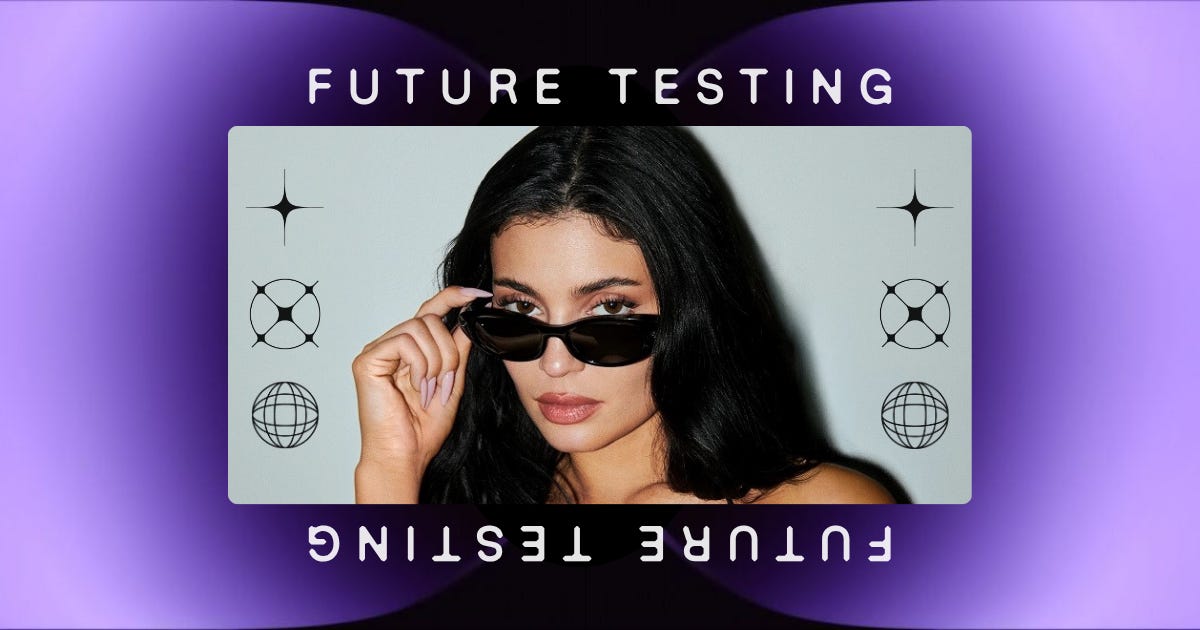
The topic for this edition practically picked itself: AI-powered, camera-equipped smart glasses, launched with fashion and celebrity backing. In May, Google and Samsung unveiled “intelligent eyewear” at Google I/O that was co‑created with eyewear brands Gentle Monster and Warby Parker. June saw Snap’s release of their SPECS, shot by Steven Meisel and fronted by multiple high-profile celebs like Kaia Gerber and Jack Harlow. Soon after, Meta announced its native “Starfire” glasses, co-designed with Kylie Jenner. It was the latter announcement that seems to have ruffled lots of feathers online.
I wanted to unpack what the arrival of these campaigns means in the longer run. For links to articles and my other references, I’ve assembled them here.
Fashion-coded smart glasses sit at a convergence of several forces. Technologically, on-device voice computing has gotten small and capable enough to disappear into an ordinary-looking eyewear frame. Culturally, tech companies like Meta are making a big push for fashion-adjacent credibility via the right brand partners and celebrities. Economically, the fashion sphere has been reciprocating by leaning into such brand-funded media and events.
Kylie Jenner’s partnership isn’t the first high-profile female endorsement for Meta, having partnered with Doja Cat for example. What’s noticeable about the Jenner collaboration is the combination of cat-eye design embedded with highly subtle cameras. The partnership has attracted accusations of using femininity to normalise a problematic technology, at a time when news headlines keep appearing about people being unknowingly filmed with smart glasses. More often than not, it’s women being filmed by men non-consensually.
With that said, here’s the spark I’m working with for this edition:
Smart glasses with near-invisible cameras are launching for a mainstream audience, fronted by celebrities and fashion houses.
Quick note before we dive into implications. My analysis is focused on the UK, where I’m based. Several stories have surfaced over here of smart glasses footage of women appearing non-consensually online, the picture here is highly sceptical of this consumer tech, perhaps even hostile. 49% of the British public support a ban on smart glasses in public spaces according to YouGov, vs. 30% opposed to one. There’s been a voyeurism conviction involving them. Emancipating something like Meta Starfire would take a lot more PR to win female consumers over here.
Which brings us to implications.
What does this change make people believe, value or desire that they didn’t before?
1st order consequence: more people start to lose sight of when smart glasses are present in the room. Some people, unconcerned with being filmed, stop caring while others become hyper-vigilant and double down on anti-surveillance protection like the Nearby Glasses app and Deveillance device. UK public suspicion remains high but the camouflage is harder to detect. Among fashion-forward adopters, good design starts to outweigh caution over features. Picking glasses to wear comes with a risk of being judged, depending on the frames.
2nd order:
Brands could pull back from mass-market positioning and pivot toward smaller, fashion-week-exclusive drops aimed at the audience the camouflage actually works on.
Wearing smart glasses convincingly could become its own status signal, less about owning the tech and more about being someone who can pull them off.
Future product launches may build privacy reassurance into the marketing itself, having watched pure aesthetic appeal fail to shift UK public opinion.
What does this change do to how people relate?
1st order consequence: wearers and non-wearers split into separate social tribes. At gyms, clubs, theatres and other venues, smart glasses get banned outright. It becomes implicit everywhere else too: people who wear them will only mingle with other wearers, and vice-versa. Trust between two people now partly depends on what they know about each other and their stance on wearables and AI, because knowing whether the person needs glasses is not enough.
2nd order:
People preferring to be closely watched by people they already know, and more uncomfortable with strangers standing near them wearing unidentifiable glasses.
Venues may increasingly need explicit ground rules about which kinds of cameras are allowed in the building, formalising what gyms and clubs are already doing informally.
Wearing camera-enabled smart glasses could become a social cue in itself, less about the device and more about which kind of person you’re signalling you are — the tech equivalent of a MAGA hat.
What does this change make obsolete, and what does that clearing make room for?
1st order consequence: the visual tell of a camera-equipped device is gone. You used to be able to spot one by how it looked, but now design can erase that completely, turning a wearable into something that just looks like ordinary glasses.
2nd order:
Detecting such a device is likely to shift from visual to technical and behavioural cues, audio interference and signal detection becoming the norm rather than the exception.
A counter-design trend could emerge, following the logic already seen in phone-free club nights, where products or spaces are designed to visibly signal “not recording” as a value proposition in itself.
Society and legal systems begin to revise “reasonable expectation of privacy”, since the old visual cue, of a raised phone or a visible lens, no longer applies.

The following vignettes serve as micro-stories, showing how these shifts in fashion, trust and visibility could play out on the ground.
Set in Soho, London, ca. 2027.
New beliefs, values, desires:
Lola steps on to the Elizabeth line platform, passes a digital billboard.
A large portrait of a model pops up. She looks familiar. It’s a campaign for a new kind of smart glasses. Completely camera-less and no microphone either. “Smart glasses with no cameras? Interesting. Must be too much money in that category, now non-creeps can own them too”, Lola thinks to herself.
On her way to the bar, she sees someone in sunglasses standing outside but there’s something off about his body language — he’s making strange gestures. He briefly talks to himself. It’s bemusing. Only for a moment though. Now she’s figured it out. Whatever those glasses are, he hasn’t got the hang of them. “Ick”, she thinks.
Relating differently:
Lola walks into the bar, checking the app DMs on the way in — he’s already arrived. The waiter points out the table where her date is sat. She’s just come in from the sun, and London has been battling another heatwave.
He nods as she approaches, smiles, introductions. She takes off the glasses at the top of her head, folds them and puts them on the table. He looks at them, comments on how they resemble the ones labelled “Fashionably Orwellian” in a Guardian exposé.
“Nope, just bog-standard frames”, she says. “I’m offended you’d ask that actually!” A pretend-shock look on her face.
They keep talking, launching into a conversation about their flags. Calling out Meta glasses in public like there’s a pickpocket: green flag. Being friends with someone who owns some: red of course. They both laugh.
Something goes away:
“Fancy another drink somewhere else?”, he asks.
Lola can be persuaded. It’s 32ºC right now and it’s Thursday.
They spot a bar with fun-looking neon signage — 1980s aesthetic. A security guard stands outside. “IDs please”, he says.
He points out to the two that all eyewear needs to be scanned before they can enter. He runs a small scanner over Lola, then her bag, a soft beep each time. Then her date. Clear.
“It’s like this everywhere now”, the security says, as he catches Lola rolling her eyes.